
When it comes to diagnosing complex conditions involving the teeth, jaws, sinuses, or facial bones, traditional X‑rays often tell only part of the story. For a detailed, three‑dimensional view that reveals anatomy with exceptional clarity, many specialists now turn to Cone Beam Computed Tomography (CBCT) . At Alsafwa Radiology Center in Sharjah, we offer this advanced imaging technology to support dentists, oral surgeons, orthodontists, and ENT specialists in delivering precise, personalised care.
This guide explains what a Cone Beam CT scan is, how it differs from conventional CT, and why it has become an indispensable tool in modern dental and maxillofacial practice.
What is a Cone Beam CT Scan?
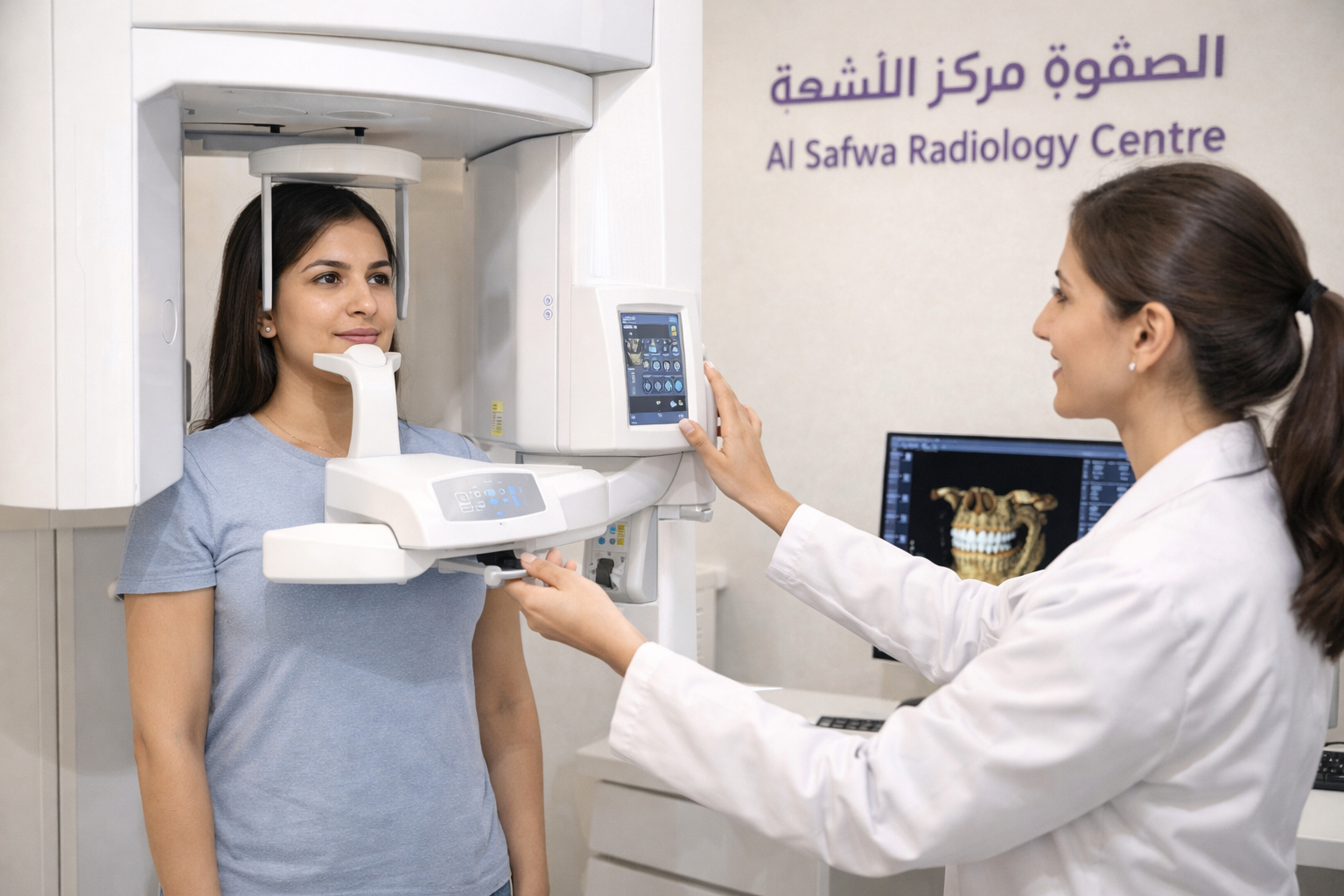
A Cone Beam CT scan (CBCT) is a specialised type of computed tomography that uses a cone‑shaped X‑ray beam and a flat‑panel detector to capture three‑dimensional images of the craniofacial region. Unlike a conventional CT scanner that takes multiple slices in a spiral pattern, CBCT rotates around the patient once, capturing hundreds of images in a single rotation. A computer then reconstructs these images into a detailed 3D volume that can be viewed from any angle.
CBCT is particularly well‑suited for imaging hard tissues—teeth, bone, and airways—with remarkable spatial resolution and significantly lower radiation dose compared to medical CT. It has revolutionised treatment planning in dentistry, oral surgery, and ear‑nose‑throat (ENT) medicine.
How is CBCT Different from Conventional CT?
| Feature | Cone Beam CT | Conventional CT |
|---|---|---|
| Beam shape | Cone‑shaped | Fan‑shaped (helical) |
| Scan time | 10–40 seconds | Several minutes |
| Radiation dose | Lower (especially for dental/head region) | Higher |
| Best for | Bone, teeth, sinuses, airways | Soft tissues, whole‑body imaging |
| Patient position | Usually sitting or standing | Lying supine |
| Cost | Generally more accessible | Higher |
Because CBCT delivers high‑resolution images of the maxillofacial region with a fraction of the radiation of a medical CT, it is the preferred modality for dental implants, orthodontic planning, wisdom tooth evaluation, and sinus assessment.
Common Applications of Cone Beam CT
1. Dental Implant Planning
CBCT allows the oral surgeon to visualise bone height, width, and density, and to locate critical structures such as the inferior alveolar nerve and maxillary sinuses. This precision ensures safe implant placement and reduces the risk of complications.
2. Orthodontic Assessment
For orthodontists, CBCT provides a 3D view of tooth roots, impacted teeth, jaw relationships, and airway dimensions. It is invaluable for planning complex cases, including surgical orthodontics and correction of skeletal discrepancies.
3. Wisdom Teeth Evaluation
When third molars (wisdom teeth) are impacted, CBCT clearly shows their position, orientation, and proximity to the mandibular nerve. This information helps oral surgeons plan extractions with confidence.
4. Temporomandibular Joint (TMJ) Disorders
CBCT can reveal degenerative changes, bone abnormalities, and asymmetry of the TMJ that are not visible on conventional X‑rays.
5. Endodontic (Root Canal) Assessment
For teeth with complex root anatomy or suspected fractures, CBCT offers a detailed view that can confirm or rule out pathology.
6. ENT and Sinus Imaging
CBCT is widely used to evaluate chronic sinusitis, nasal polyps, and sinus anatomy prior to functional endoscopic sinus surgery (FESS).
7. Oral Pathology and Trauma
Cysts, tumours, fractures, and other pathologies of the jaws and facial bones are clearly delineated on CBCT, aiding in diagnosis and treatment planning.
What to Expect During Your Cone Beam CT Scan at Alsafwa
Preparation
- No special preparation is usually required.
- You will be asked to remove any metal objects (jewellery, glasses, hairpins, removable dental appliances) that could interfere with the image.
- If you are or may be pregnant, please inform the staff; elective imaging is generally postponed during pregnancy.
During the Scan
- You will be seated or standing, depending on the equipment. A chin rest and forehead support help keep your head perfectly still.
- The scanner rotates around your head for 10–40 seconds. You will be asked to remain still and may be asked to hold your breath briefly for sinus images.
- The process is quiet and non‑invasive. There is no enclosed tunnel, so patients who are claustrophobic typically find CBCT very comfortable.
After the Scan
- You can resume your normal activities immediately.
- A specialist radiologist with expertise in maxillofacial imaging will review the 3D data and generate a detailed report for your referring dentist or physician, usually within 24 hours.
- You may receive a copy of your scan on a CD or USB drive for your records or for sharing with your specialist.
Safety and Radiation Considerations
CBCT uses ionising radiation, but the effective dose is significantly lower than that of a conventional medical CT of the head. Modern CBCT units at Alsafwa employ strict dose‑optimisation protocols:
- Field of view (FOV) is tailored to the region of interest, minimising exposure.
- Paediatric protocols reduce settings for younger patients.
- ALARA principle (As Low As Reasonably Achievable) is strictly followed.
The benefit of an accurate diagnosis that guides appropriate treatment far outweighs the minimal radiation risk. If you have concerns, your referring doctor and our radiology team are happy to discuss them.
The Role of the Radiologist
While CBCT images are often used by dentists and surgeons, the interpretation by a trained radiologist adds an essential layer of expertise. At Alsafwa Radiology Center, our radiologists have specialised knowledge in maxillofacial anatomy and pathology. They provide a comprehensive report that highlights not only the specific area of interest (e.g., implant site) but also any incidental findings that may require attention—ensuring you receive complete, coordinated care.
Why Choose Alsafwa Radiology Center for Your CBCT Scan?
- State‑of‑the‑art CBCT technology – High‑resolution imaging with low radiation.
- Experienced radiologists – Specialists in dental and maxillofacial imaging.
- Patient comfort – Open, seated or standing design eliminates claustrophobia.
- Fast turnaround – Reports delivered promptly to your referring practitioner.
- Central location in Sharjah – Convenient access for patients across the emirate.
Conclusion
Cone Beam CT has transformed the way dental and ENT specialists diagnose and treat conditions affecting the teeth, jaws, sinuses, and facial structures. By providing a detailed 3D view with low radiation exposure, it enables safer, more predictable outcomes. At Alsafwa Radiology Center in Sharjah, we are proud to offer this advanced imaging service to support your healthcare journey. If your dentist, orthodontist, or surgeon has recommended a CBCT scan, you can trust that you are in expert hands.
FAQ: Cone Beam CT Scan/h2>
A: No, the scan is completely painless. You simply sit or stand still while the machine rotates around your head.
A: The actual scan time is usually between 10 and 40 seconds. The entire appointment, including positioning and preparation, typically lasts 10–15 minutes.
A: The radiation dose is much lower than a conventional medical CT and is comparable to a few days of natural background radiation. We use dose‑optimised protocols to keep exposure as low as possible.
A: Yes, a referral from a dentist, orthodontist, oral surgeon, or ENT specialist is required. This ensures the scan is medically indicated and targeted to your specific needs.
A: As with any X‑ray based examination, CBCT is generally avoided during pregnancy unless absolutely necessary. Please inform our staff if you are or may be pregnant.
A: Wear comfortable clothing. You will be asked to remove any metal objects from the head and neck area, including jewellery, glasses, and hair clips.
A: You may receive a copy of your scan on a CD or USB drive at the end of the appointment. A formal radiology report will be sent to your referring practitioner within 24 hours.
- Tags:
- sharjah ct scan
- uae scan