
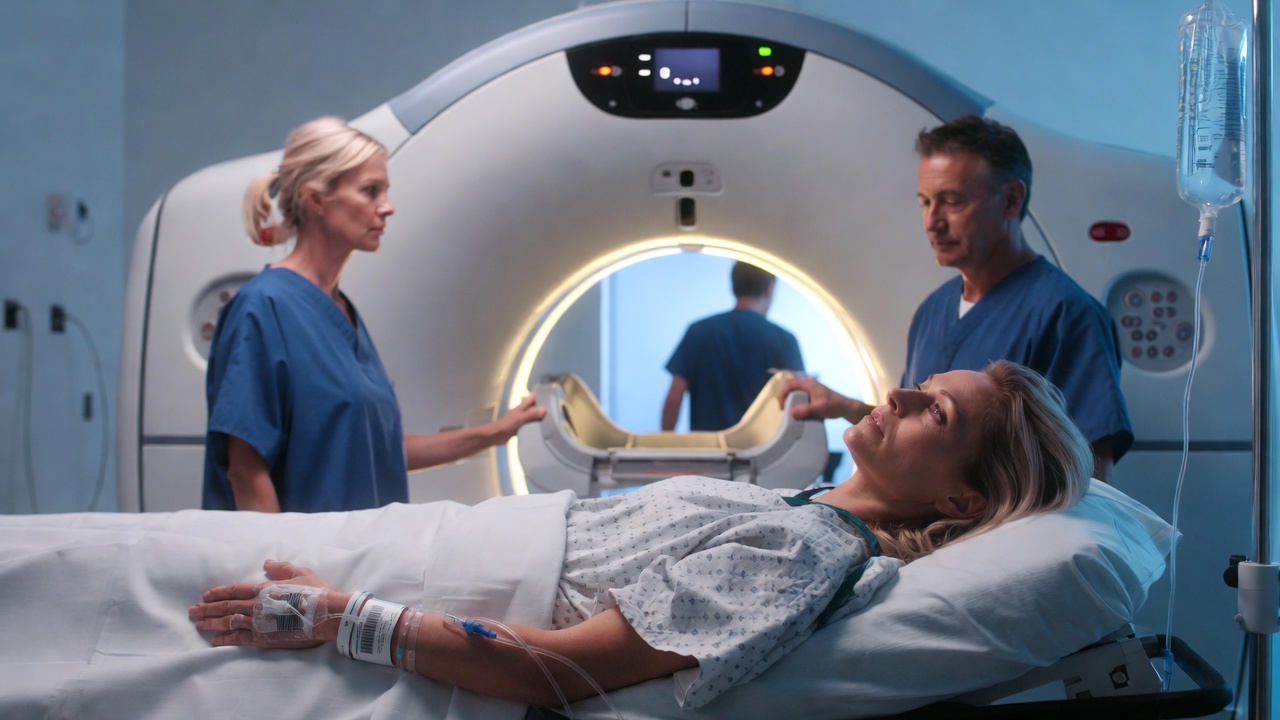
Let’s paint a familiar scene. You’re in the Emergency Department, or a loved one is. Things are moving quickly. The doctor is concerned, talks about a potential bleed, a possible stroke, or internal injury, and says, “We need to get an emergency CT scan, now.” In that moment of stress, it’s completely normal to think: “Why? Is this really necessary? What are they looking for?”
The answer, in one word, is clarity. And in an emergency, clarity isn’t just valuable—it’s life-saving. For patients and families in Sharjah and across the UAE, understanding the critical role of CT in emergency care can ease anxiety and highlight why speed is so crucial.
The Emergency CT: Your Body’s Instant Internal Map
Unlike an X-ray which shows mainly bone, a CT (Computed Tomography) scanner uses X-rays and advanced computing to create detailed, cross-sectional images of your body—like slicing a loaf of bread to see every detail inside. In minutes, it gives doctors a clear, comprehensive view of your brain, chest, abdomen, or spine.
This fast CT scan capability transforms decision-making in the ER. When a condition is evolving by the minute, waiting for answers isn’t an option. This is the core of emergency radiology.
Key Moments When an Emergency CT is Critical
1. Suspected Stroke: The Race Against Time
This is one of the most time-sensitive situations in medicine. There are two main types of stroke: ischemic (a blocked artery) and hemorrhagic (a bleed in the brain). The treatment for each is completely different; giving the wrong treatment could be catastrophic.
- The Role of CT: An immediate stroke diagnosis CT can instantly show if there is bleeding. This allows doctors to swiftly rule out a hemorrhage and, if appropriate, administer clot-busting medication to save brain function. Every 60 seconds, millions of brain cells are at stake.
2. Major Trauma: The Unseen Injury
After a serious car accident, fall, or impact, the external injuries might be obvious. But what about internal damage? A bruised spleen, a liver laceration, internal bleeding, or spinal fractures might not be immediately apparent.
- The Role of CT: Trauma imaging with a full-body or targeted CT scan is the gold standard. It rapidly reveals internal injuries, guiding surgeons directly to the problem and helping them decide if an emergency operation is needed.
3. Severe Abdominal Pain: Solving the Mystery
Sudden, agonising abdominal pain can have multiple causes: appendicitis, a ruptured organ, a bowel obstruction, or an aortic aneurysm.
- The Role of CT: It acts as a diagnostic powerhouse, quickly identifying the source of the problem—like showing an inflamed appendix or a leaking aneurysm—allowing for immediate and accurate surgical planning.
4. Unexplained Severe Headache or Mental Change
If someone presents with the “worst headache of their life” or sudden confusion, doctors must rule out life-threatening causes like a brain aneurysm rupture or other bleeding.
- The Role of CT: A head CT provides immediate evidence of bleeding or other pressure on the brain, enabling neurosurgeons to intervene urgently.
The Process: Speed, Safety, and Expertise
When you hear “emergency CT scan,” the process is streamlined for urgency:
- No Appointments, No Wait: In the ER, the scan is done as an immediate priority.
- Safety First: While CT uses radiation, the dose is carefully minimised, especially for children. The benefit of obtaining a critical, life-saving diagnosis far outweighs the minimal risk.
- Expert Read: The images are instantly sent to a radiologist specialising in emergency radiology—a doctor trained to spot critical findings under pressure. Their rapid report goes straight to your ER doctor, closing the loop quickly.
In essence, an emergency CT scan is not just a test; it’s a pivotal decision-making tool. It replaces uncertainty with information, guesswork with a guided plan, all within those crucial minutes that can define the outcome.
FAQ: Emergency CT Scans Explained
A: In an emergency situation, the benefit of getting a rapid, accurate diagnosis to guide life-saving treatment is paramount. Radiologists use the lowest possible radiation dose to get the necessary images. Your medical team will only recommend it when the clinical need is urgent.
A: In true emergencies, the fast CT scan process is designed for speed. The radiologist will often review the images immediately and communicate critical findings directly to the ER doctor within minutes. A formal report follows shortly after.
A: Usually, no. There’s no fasting or special preparation. The focus is on speed. You may be given a contrast dye through an IV to make certain tissues or blood vessels clearer, which the team will explain quickly.
A: CT scans are much faster (seconds vs. minutes) and are excellent for visualising bone, acute bleeding, and major organs. MRI provides different, more detailed soft tissue information but takes longer and is less accessible in the middle of the night. CT is typically the first-line critical care imaging tool in emergencies.
A: This is a careful risk-benefit discussion. The Al Safwa team will shield your abdomen if possible and only proceed if the scan is absolutely essential to diagnose a life-threatening condition for you. Alternative imaging like ultrasound may be considered first.