Let’s talk about heart health. It’s a priority for all of us. The thought of “what if something’s wrong with my heart” can cause real stress. Usually, doctors suspect blockages in the arteries around your heart. The gold standard test has been a traditional coronary angiogram. But that test has a major drawback. It’s invasive. It requires threading a thin tube, called a catheter, from an artery in your groin or wrist all the way up to your heart.
What if you could skip the tube? What if you could get detailed 3D pictures of those same arteries in just a few minutes? And what if you could do it without a hospital stay? That’s where a CT Coronary Angiogram (CCTA) comes in. It’s a modern, non‑invasive game‑changer for heart diagnostics.
How This Non‑Invasive Scan Works
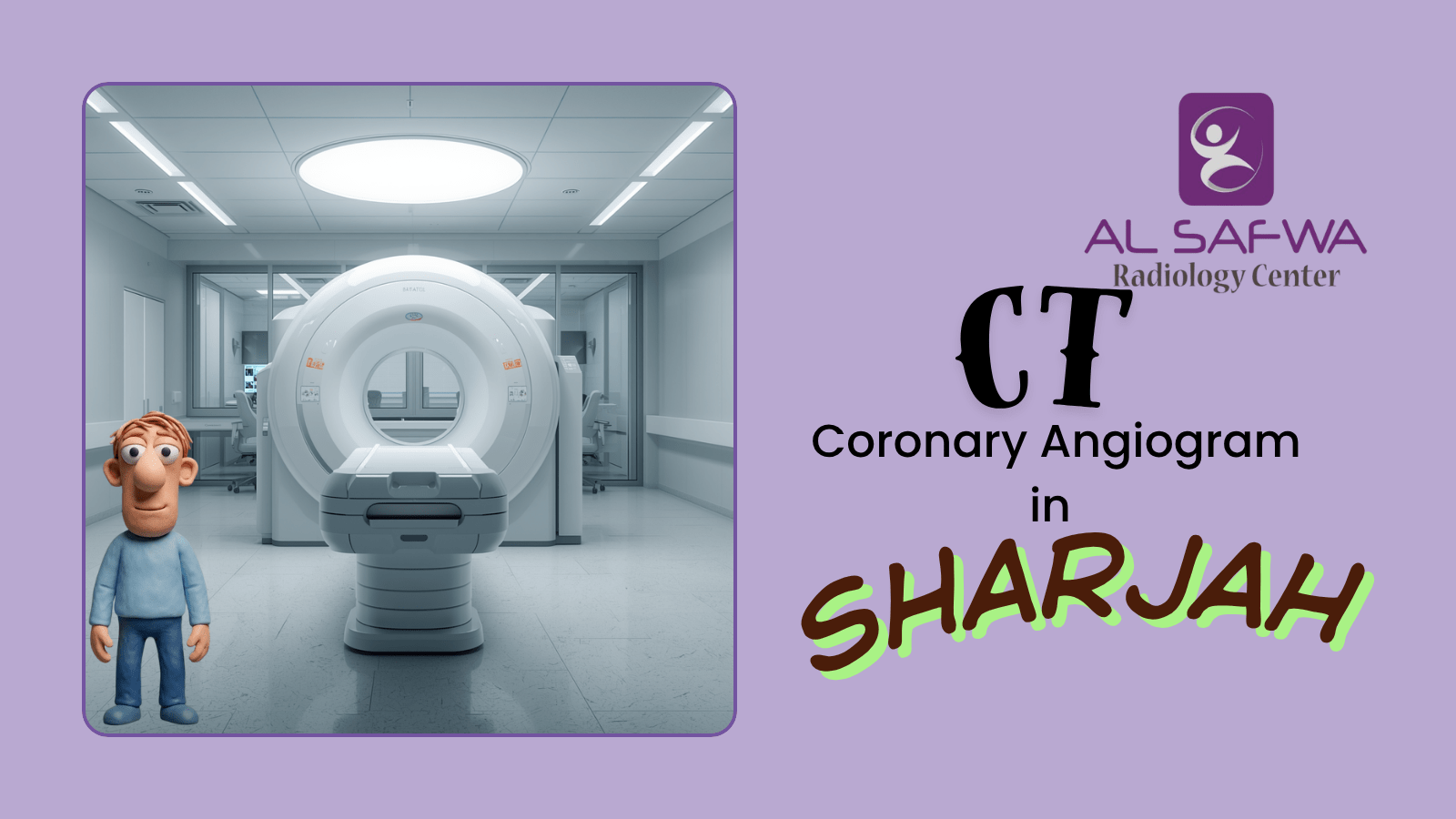
So how does a CCTA work? It’s a specialized type of CT Scan in Sharjah. You simply lie down on a comfortable table. The table slides into our advanced 64‑Slice CT scanner. A technician injects a small amount of iodine‑rich contrast dye into a vein in your arm. This feels similar to a routine blood draw. The dye acts like a highlighter. It illuminates your heart’s blood vessels.
The scanner then moves around you. It takes incredibly fast and detailed X‑ray pictures. Our 64‑slice technology captures images with sub‑millimeter precision. This allows the scanner to see tiny areas in your arteries. Standard scans often miss these details. A computer then stitches the slices together. The result is one ultra‑high‑resolution 3D model of your heart and arteries.
Your cardiologist can now see exactly where narrowing or plaque buildup might hide. Think of it as a high‑definition satellite map of your heart. It’s far better than a blurry, old black‑and‑white photo.
Why Choose a CT Coronary Angiogram?
The benefits go beyond just comfort. This scan gives doctors the power to quickly rule out heart disease in stable patients. It offers high accuracy with minimal risk. Here’s what you gain:
- Fast and efficient. The entire scan takes only a few minutes. It’s much less daunting than invasive tests.
- Lower risk. No catheter enters your heart. This significantly reduces serious complications like bleeding or infection.
- Superb accuracy. For many patients, the CCTA matches the invasive method’s accuracy. It can even help avoid unnecessary invasive procedures entirely.
Your Step‑by‑Step Guide to the Scan
Preparing for your scan is easy. Just follow these simple steps.
Step 1: Skip the meal. Stop eating and drinking about 4 hours before your scan. You can usually have small sips of water.
Step 2: Ditch the caffeine. No coffee or tea beforehand. We need your heart rate to stay nice and steady.
Step 3: Watch the meds. Avoid Viagra and similar medications on the day of your test.
Step 4: Comfort is key. Wear loose, comfortable clothing. Leave your jewellery at home.
Step 5: Heart monitoring. When you arrive, we place small sticky electrodes on your chest. These monitor your heartbeat during the scan.
Step 6: The scan itself. The table moves back and forth through the “donut”‑shaped scanner. It’s quick and painless.
After the scan, you can hop off the table. Go about your normal day. Our emergency radiology team then gets to work. They analyze your fast CT scan results.
When Should Your Doctor Recommend This Scan?
Your doctor might recommend this advanced critical care imaging test in several situations. You may have new or worsening chest pain (angina). You might feel shortness of breath. Or you may have other risk factors for heart disease. The CCTA is an invaluable tool. It helps your doctor plan the right treatment. That plan could include lifestyle changes, medication, or a more interventional procedure.
Final Thoughts
Your heart deserves the best care. A CT Coronary Angiogram offers a safe, fast, and accurate way to check your coronary arteries. No hospital stay. No invasive catheters. Just clear answers and peace of mind.
A: Not at all. The only possible sensation is a slight pinch from the IV when the contrast dye is injected, and a brief warm feeling as the dye travels through your body.
A: A traditional angiogram is invasive and requires inserting a catheter into your artery. A CCTA is non-invasive, using only an IV and a CT scanner, which is generally safer, quicker, and more comfortable for the patient.
A: Most patients report a warm, flushing sensation that spreads through their body and a metallic taste in their mouth. This is completely normal and passes within a minute or two.
A: The scan uses modern 64-Slice technology that minimizes your radiation exposure. Some patients may have a mild allergic reaction to the iodine contrast dye, so we will thoroughly screen you for any allergies beforehand.
A: While the scan itself is just minutes, you should plan to be at the centre for about 45 minutes to an hour to allow for preparation, IV placement, the scan, and a short observation period afterwards.
A: A specialist radiologist will analyze your images and send a detailed report to your doctor, usually within 24 hours. Your physician will then call you to discuss the findings.